
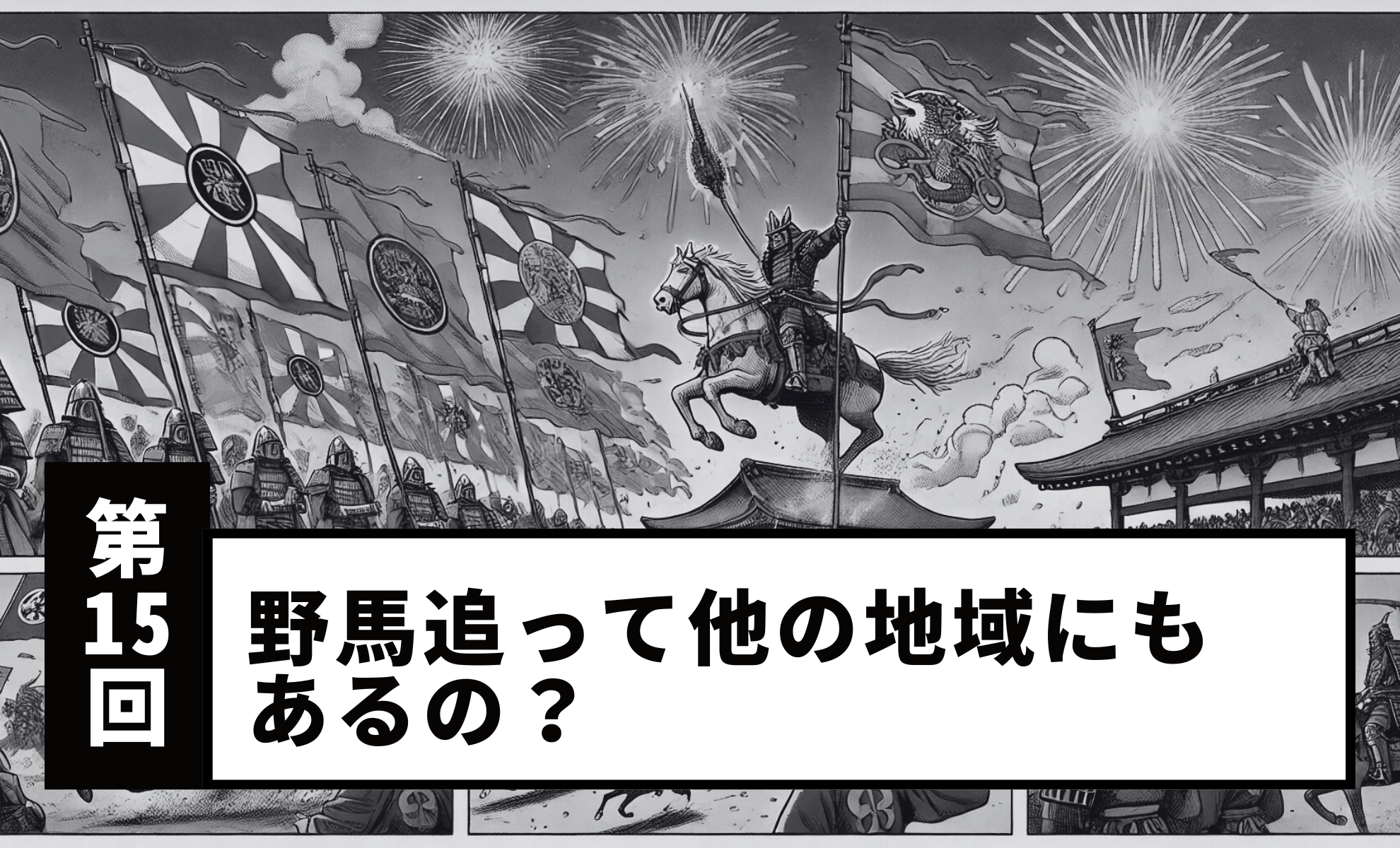
The Soma Nomaoi is a traditional festival held in the Soma region of Fukushima Prefecture, widely known as a grand equestrian event originating from samurai military training. However, similar “Nomaoi” customs historically existed in regions beyond Soma as well.
1. Nomaoi in the Kantō Region
The Kanto region once had numerous horse pastures called “maki,” where samurai engaged in “nomakake” (wild horse capture). The custom of nomaoi is believed to have persisted particularly in Chiba and Ibaraki Prefectures from the medieval period through the Edo period.
Chiba Prefecture (Shimōsa Province)
Records indicate nomaoi was practiced as part of combat training in the Kantō region, which was ruled by Taira no Masakado.
During the Edo period, nomaoi was also practiced in domains like Sakura Domain to manage wild horses.
Ibaraki Prefecture (Hitachi Province)
Events similar to nomaoi existed as military training for samurai, particularly utilized during the Warring States period to hone mounted combat tactics.
2. Nomaoi in the Kyushu Region
Similar to the Kanto region, a culture akin to nomaoi was also transmitted to parts of the Kyushu region.
Kumamoto Prefecture (Aso Region)
Horse breeding has flourished here since ancient times, and it is said that a culture of capturing and training wild horses existed on Aso's pastures.
Miyazaki Prefecture (Takachiho Region)
There are areas where rituals involving the offering of wild horses to the gods are performed, showing common ground with the spirit of the wild horse chase.
3. Why the Wild Horse Chase Survived Especially in Soma
Today, the event widely known as “Nomaoi” is the “Soma Nomaoi” in the Soma region. The reasons for this prominence include:
The Soma clan ruled for a long period and continued Nomaoi as a clan event.
It became established as a festival centered around the Soma Three Shrines (Soma Nakamura Shrine, Soma Ota Shrine, Soma Odaka Shrine).
The local people continued to preserve the tradition even after the Meiji period.
Summary
Historically, events and customs similar to the wild horse chase were observed throughout Japan, including in the Kantō and Kyūshū regions. However, in the Sōma region, the tradition became deeply intertwined with samurai culture and faith, continuing to this day as a source of local pride. Consequently, when people refer to the “wild horse chase” today, they generally mean the “Sōma Nomaoi.”
We hope this tradition continues to be passed down and becomes known to many people!


![[Part 13] Before Starting the Soma Nomaoi School](https://en.soma-nomaoi.com/wp-content/uploads/2024/12/vol13_title-150x150.png)