
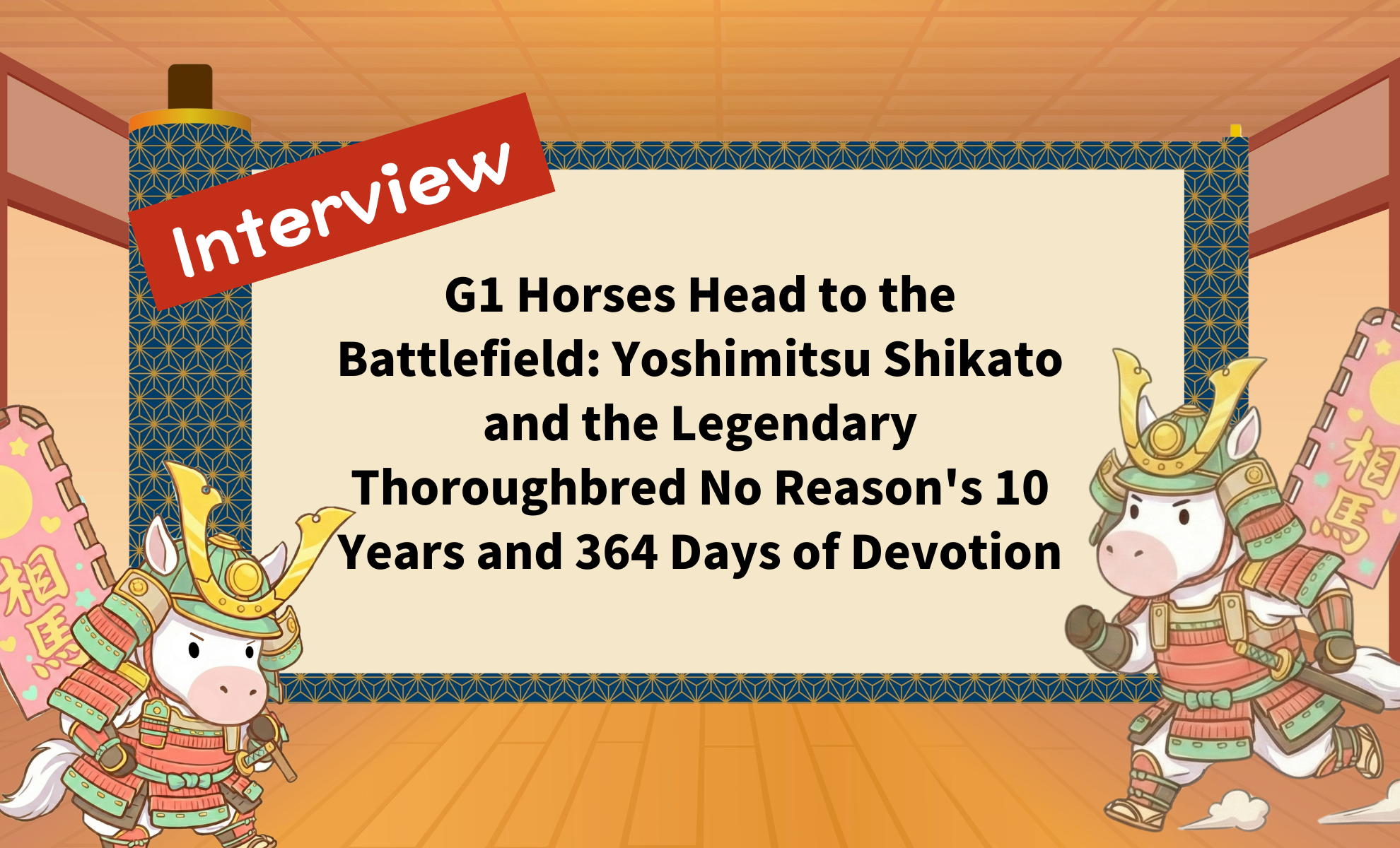
The Soma Nomaoi is a traditional event with over a thousand years of history, and at the same time, it is a rare stage where retired racehorses embark on a second life. The beloved horse of Kagashira Yoshimitsu, the mounted warrior of Kitago, is the renowned steed “No Reason,” who once won the G1 race (Satsuki Sho) in central horse racing. It is extremely rare for a horse with such a brilliant record during its active career to participate in a regional traditional event after retirement.
The decade-plus journey shared by Mr. Shikato and No Reason transcends the typical jockey-horse relationship, highlighting a deep bond as comrades-in-arms and the dedicated efforts of those upholding tradition.
1. The Legendary Successor: A G1 Horse Descends Upon the Battlefield
Q: Please tell us about your encounter with No Reason.
Mr. Yoshimitsu Shikato (hereafter Shikato): After retiring, No Reason came to me via a riding club in Minamisōma. It's truly rare for a G1 horse to compete in the Nomadori. For over a decade, he served as my partner in the Nomadori. He symbolizes how the Nomadori has become an important second career venue for retired horses.
Q: How did his G1 pedigree and temperament manifest in the Nomadori?
Shikato: At the time of the interview, he was 25 years old (equivalent to a late-stage elderly human), but his “strong-willed nature remained unchanged from his active days.” Especially during the sacred flag battle, he displayed a fighting spirit, determined to push forward even if it meant kicking aside the horse next to him, clearly retaining the pride of a G1 winner.
2. Switching to Combat Mode: The State of Horse and Rider as One
Q: The Nomaki festival is an extremely harsh environment for horses, with the roar of fireworks, the sound of conch shells, and fluttering finger flags. How did No Reason react?
Shikato: You might be surprised, but he remained completely unfazed. While most horses would likely panic in such conditions, his thick nerves ensured safe riding and stability within the procession.
And what moved me most was that when I began putting on my armor and tacking him up, No Reason would instinctively tighten his belly, brace his body, prick his ears, and enter “combat mode.” This perfect harmony is the state of unity between rider and horse cultivated over ten years—proof of a deep trust that cannot be achieved through mere training alone.
Characteristics Details Impact on the Nomaoi Mental Fortitude Unflappable nerves unaffected by thunderous noise or flags Safe riding, stability in processions Fighting Spirit Temperament to intimidate neighboring horses and push forward Advantage in the sacred flag competition (during active duty) Intelligence Switches to “combat mode” upon seeing armor Cooperative from the preparation stage Stamina Still energetic in his mid-20s, but requires consideration for his advancing age Shifted to participation in processions only
3. 364 Days of Dedication: The Reality of Horse Ownership
Q: What kind of dedication is required for the remaining 364 days to enter No Reason in the Nomaoi?
Shikato: “It's different from dogs or cats.” The financial and physical burdens are enormous.
• Feed costs: Over ¥30,000 per month (impacted by rising prices)
• Shoeing: Every two months, a significant expense
• Management: Morning and evening feeding, cleaning, securing bedding (rice husks)
• Transportation: Vehicle maintenance costs, fuel expenses
Especially during the earthquake disaster, when feed was hard to come by, I stayed behind to protect the horse. The phrase “we walked the road to recovery together” conveys a deep affection for No Reason as a comrade-in-arms, beyond just a pet or tool.
4. Honorable Retirement, and Farewell
Q: I understand Noruison passed away just days after this interview.
Shikato: Yes. He passed away peacefully under my attentive care until the very end. Though advanced in age, I believe he maintained his pride as a samurai horse right up until his final moments on the Nomaoi stage.
Q: What does your experience with No Reason at the Nomaoi festival mean to you, Mr. Shikato?
Shikato: He taught me the weight of preserving tradition and the responsibility of caring for a life. And I believe he showed many people the hope that retired racehorses can find a place to shine again within the community. His spirit will live on in the land of Soma.
![[Part 13] Before Starting the Soma Nomaoi School](https://en.soma-nomaoi.com/wp-content/uploads/2024/12/vol13_title-150x150.png)