
![[Part 3] Among the warriors participating in the Nomaoi festival, who is the most senior?](https://en.soma-nomaoi.com/wp-content/uploads/2024/10/vol3_title.png)
Approximately 400 mounted warriors take part in the Soma Nomaoi. The warrior who commands them is the “Commander-in-Chief.” Traditionally, the role of General Commander is held by the head of the Soma family, descendants of the feudal lords who once ruled the Soma region. However, in years when the head of the Soma family cannot participate, the role is filled by a member of the Soma family's senior retainer house (a particularly high-ranking family among the vassals) or the Mayor of Soma City.
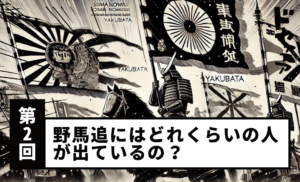
Unlike the mounted warriors, the Commander-in-Chief wears a large, conspicuous piece of equipment on his back called a “horo” (banner). This “horo” is inflated like a balloon and is a vivid crimson color. Above the horo is a further distinctive decoration, indicating which lineage the Commander-in-Chief belongs to that year.
Meaning of the Horo Ornaments
The ornaments on the horo have the following meanings:
Three Fans (Ougi)
Attached when the main branch (honke) of the Soma family serves as General Commander. Only a limited number of individuals belong to the main branch; currently, only the head of the Soma family and his son can wear these fans.
Moon and Tansaku
These are worn when a commander-in-chief from outside the main family serves. For example, this decoration is used when the head of the family retainer house or the mayor becomes commander-in-chief.
Simply by observing the decorations on the mō, one can discern the lineage and role of the commander-in-chief. When visiting the festival, taking the time to carefully observe these decorations can be quite interesting.
Other Roles and Mō Colors
Positions other than the Grand Commander also wear “moe” decorations. Among these, the Deputy Commander (Fukudaisho) and the Village Commander (Godaishō) are particularly important. They each wear moe of different colors. For example, while one Village Commander might wear a yellow moe, another might wear a blue one. These color differences indicate their respective roles and the regions they represent.
Information from the locals
During the Soma Nomaoi procession, local high school students and government officials provide commentary over microphones. They clearly explain detailed information like the history of the mounted warriors, the armor, and the meaning of the mōi, making it incredibly enjoyable just to listen.
Hearing explanations like, “This person is the Sōma family's main branch General Commander,” or “This Gōdaishō has brought a new horse this year,” will make the festival feel even more fascinating.
![[Part 13] Before Starting the Soma Nomaoi School](https://en.soma-nomaoi.com/wp-content/uploads/2024/12/vol13_title-150x150.png)