
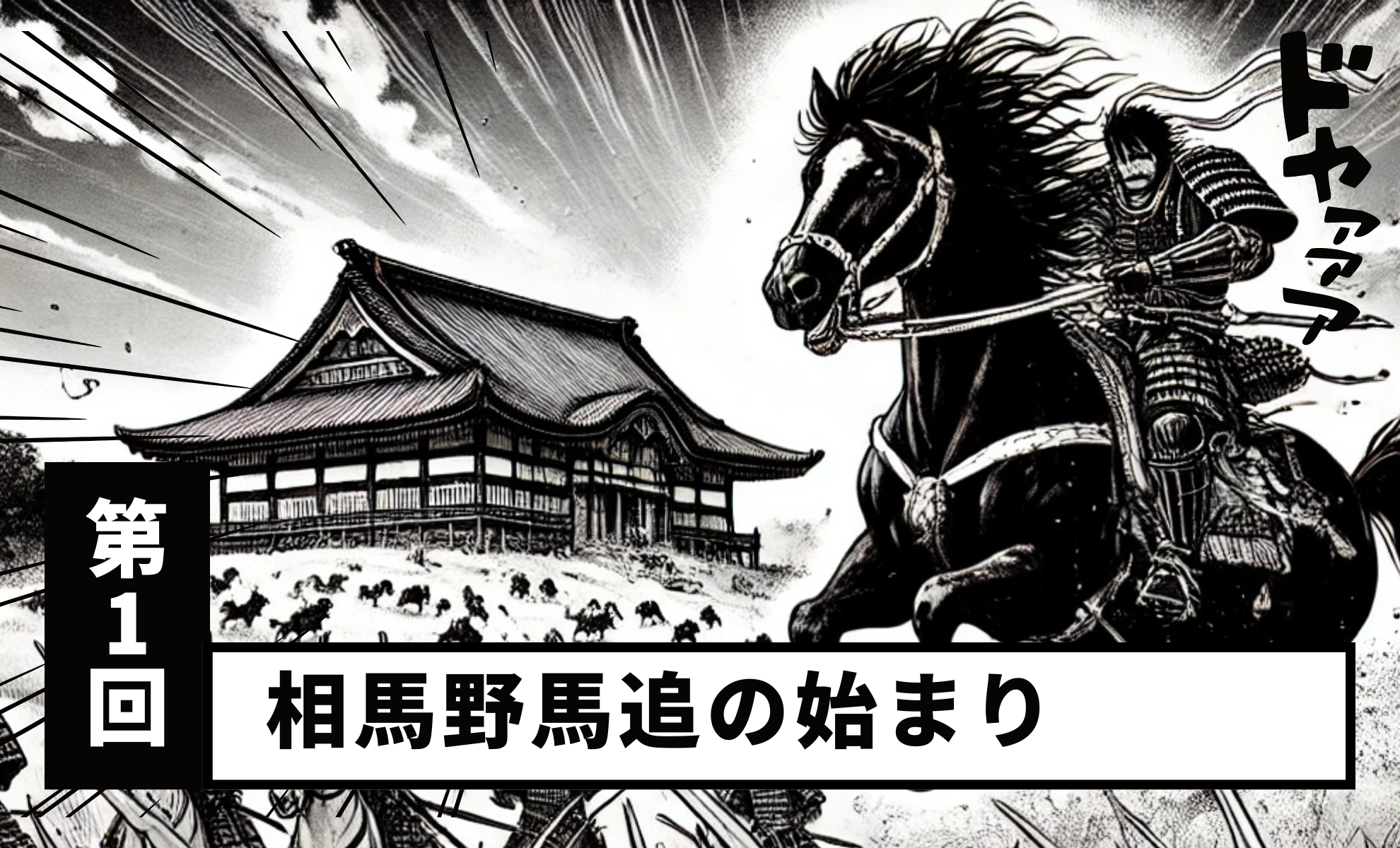
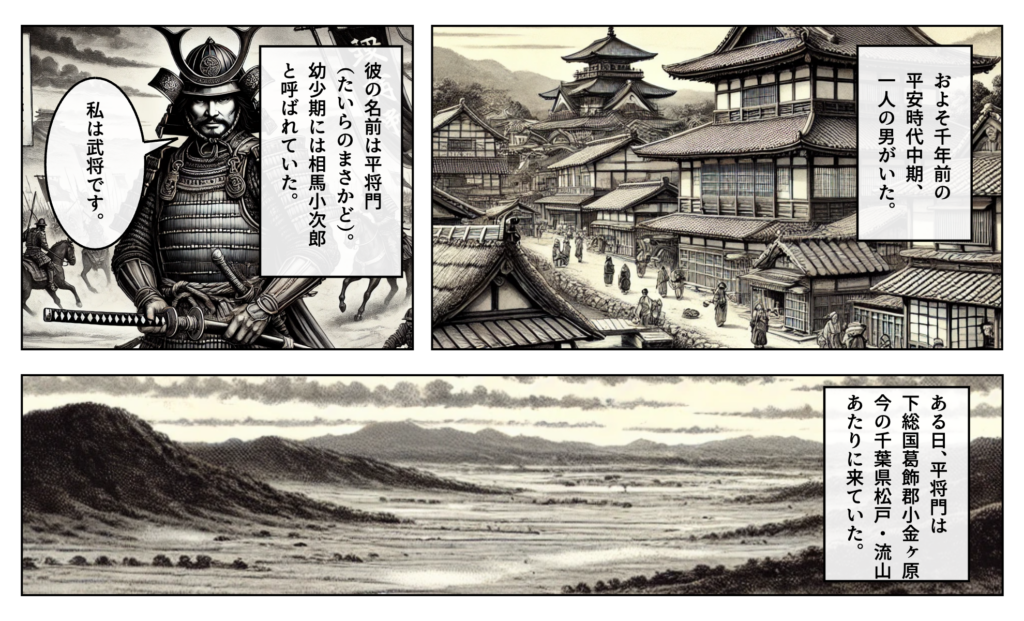
The Soma Nomaoi is said to have begun long ago, in the mid-Heian period (over 1,000 years ago).
Its origin is traced to Taira no Masakado (known as Soma Kojiro in his childhood) capturing wild horses in the fields of Koganehara in Katsushika District, Shimōsa Province (present-day Matsudo and Nagareyama areas in Chiba Prefecture) and dedicating them to a shrine.
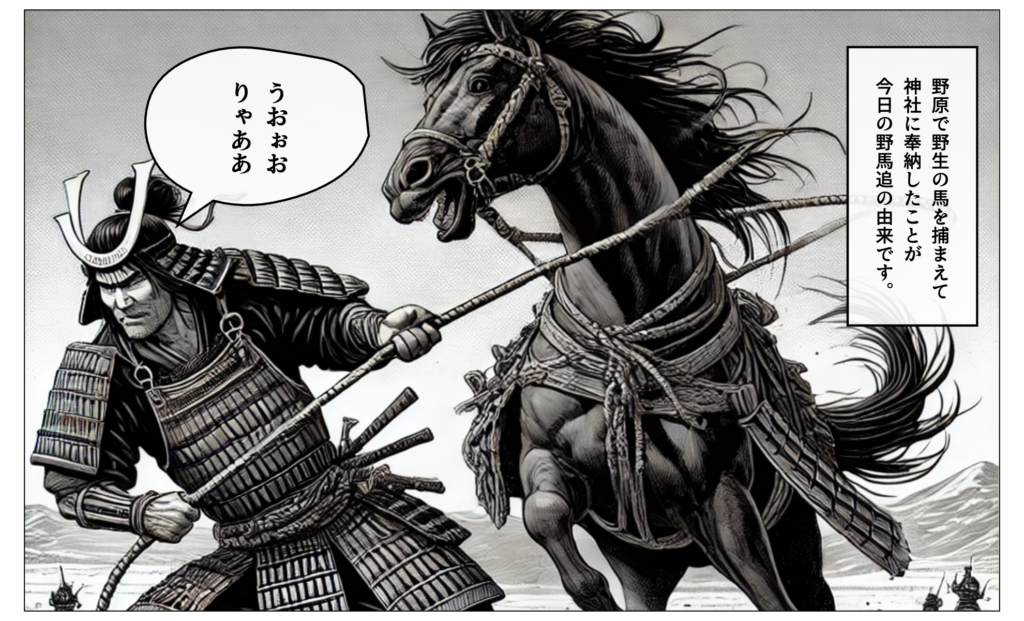
When you visit a shrine to make a wish, do you write your thoughts on an ema?
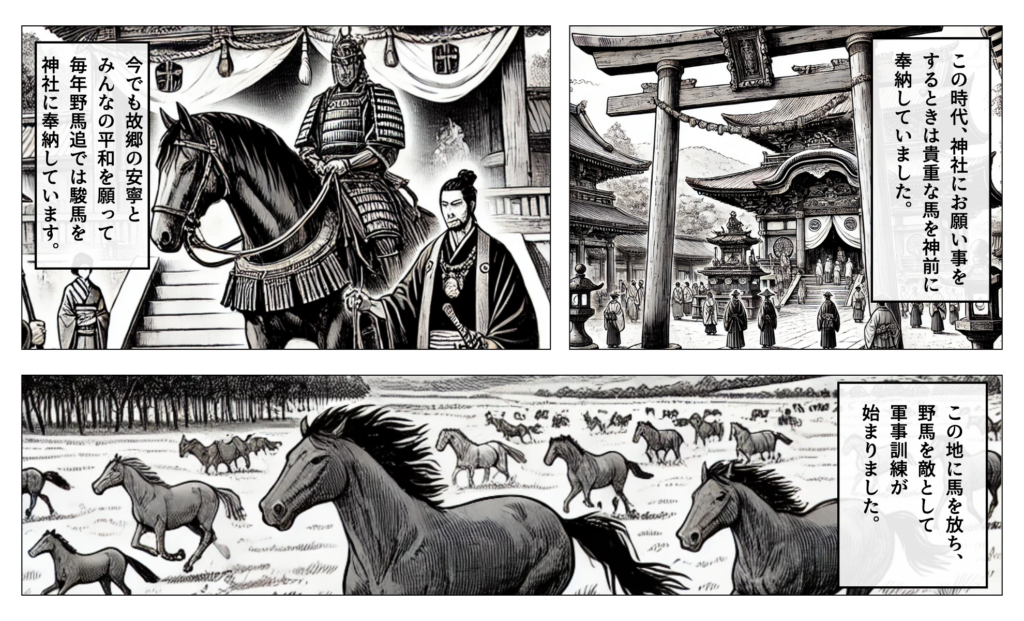
In the past, horses were extremely valuable (and still are today), so when making wishes at shrines, people would offer their most precious horses as sacred horses before the deity.
In modern times, dedicating horses is difficult, so the practice of ema was born.
In Soma, even today, to pray for the peace of the homeland and the safety of its people, swift horses are dedicated to the shrine every year during the Nomaoi festival. (This event, called Nomakake, is the most important part of the Soma Nomaoi. I'll share the details another time.)
Ancient texts state: “After Masakado ruled the eight provinces of Kanto, he released horses in Koganehara, Katsushika District, Shimousa Province (present-day northwestern Chiba Prefecture). Twice or thrice yearly, in spring, summer, and autumn, he gathered troops from eight provinces. Clad in armor, he trained vast armies, using wild horses as foes. He tested military preparations, the freedom of reins, horsemanship, and agile maneuvers.”
The origins of the Wild Horse Chase lie in military training conducted to protect their homeland.
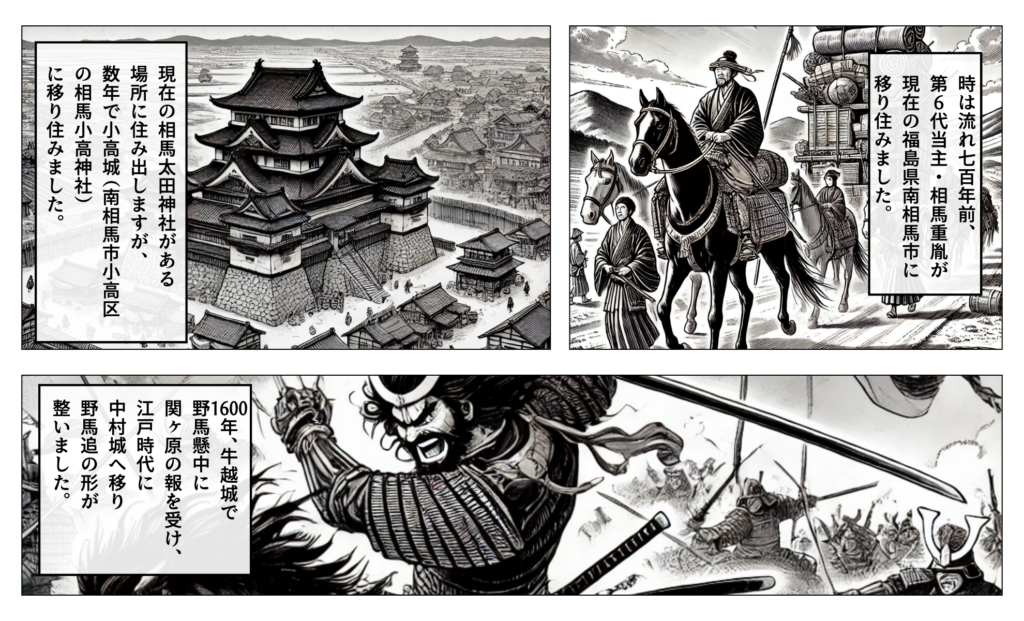
Time passed, and in 1323 (about 700 years ago), the sixth head of the family, Soma Shigetane, moved to Ota Village in Mutsu Province's Namegata District (present-day Nakaota, Haramachi Ward, Minamisoma City, Fukushima Prefecture).
He settled in the location where Soma Ota Shrine now stands, but within a few years, he relocated to Odaka Castle (Soma Odaka Shrine in Odaka Ward, Minamisoma City).
Similar to the ancient nomaoi tradition, the Soma clan released horses onto the nearby plains near Ota Village, and it is said they continued this practice intermittently thereafter.
Details of this period's wild horse chasing are unclear due to scarce records. Time passed again, and in 1600, while performing nomakake (horse-chasing ritual) at Ushikoshi Castle (Haramachi Ward, Minamisoma City), which served as their castle at the time, they reportedly received news of the Battle of Sekigahara. It is thought they continued the wild horse chasing even after relocating. During the Edo period, the residence was moved to Nakamura Castle (present-day Soma Nakamura Shrine in Soma City), which remained the Soma clan's castle until the Meiji era. It is from this period that we begin to see the origins of the Soma Nomakake as it is practiced today.
The 19th head of the Soma clan, Tadatsugu, decided to establish pastures on the wilderness and conduct the Nomadori horse chase there.
The current Hibari-ga-hara festival grounds are part of that area.
With the Meiji era came the end of the samurai society. Horses that had been grazing freely on the Nomai Plains were captured, and the Nomai, once an annual event for the Soma family, could no longer be held.
However, as a festival for the Soma Sanja shrines (Soma Ota, Odaka, and Nakamura Shrines), which enshrine Myoken, the guardian deity of the Soma family, the Nomai has persevered through countless hardships. No matter what happens, it continues to this day, carrying on the teachings of our ancestors.
![[Part 3] Among the warriors participating in the Nomaoi festival, who is the most senior?](https://en.soma-nomaoi.com/wp-content/uploads/2024/10/vol3_title-150x150.png)